 f65f7b347e
A user in the Pending Approval state could complete SSO and reach any
SSO-protected reverse proxy service distributed to a group they belong
to, including the All Users group. The reverse proxy authorization path
checked the session token signature, that the user exists, that the
user's account matches the service's account, and group membership —
never the user's account status. The REST API (`permissions/manager.go`)
and peer registration both gate on that state, but the proxy gRPC
service does not go through the permissions manager, so neither gate
applied. A pending user is persisted as blocked and pending approval, so
blocked users reached those services the same way.

`ValidateSession` now denies on account status, reporting
`pending_approval` or `user_blocked` so the proxy access log and the
denied page carry the cause rather than a generic refusal.
`GenerateSessionToken` refuses to mint a token for such a user at all,
so the browser never receives a session cookie and the OIDC callback can
tell the user why instead of showing "Service configuration error".
`ValidateUserGroupAccess` and `ValidateTunnelPeer` close the same gap;
for the tunnel path this covers a user blocked after their peer was
registered, since peer group membership alone kept mesh-origin access
open.

A single helper produces both the denied reason for the RPC responses
and the sentinel error for the error-returning callers, so the four
entry points cannot drift apart. A user the store cannot resolve is
denied rather than passed through.

One thing deliberately left out: session cookies are validated locally
by the proxy against the service public key with no management
round-trip, so a cookie issued before a user is blocked stays valid
until it expires (24h by default). That is a revocation-propagation
problem rather than this authorization gap, and every option for it
(per-request validation with a cache, short-lived tokens with refresh,
push-based revocation) changes the proxy hot path or the
proxy/management protocol. Worth its own ticket.





Start using NetBird at netbird.io
See Documentation
Join our Slack channel or our Community forum
🚀 We are hiring! Join us at https://netbird.io/careers
🤖 NetBird Agent Network (Beta)
Identity-aware access control for AI agents — keyless access to LLM APIs and private resources over the encrypted NetBird tunnel. See
agent-network/or read the docs at netbird.ai.
NetBird combines a configuration-free peer-to-peer private network and a centralized access control system in a single platform, making it easy to create secure private networks for your organization or home.
Connect. NetBird creates a WireGuard-based overlay network that automatically connects your machines over an encrypted tunnel, leaving behind the hassle of opening ports, complex firewall rules, VPN gateways, and so forth.
Secure. NetBird enables secure remote access by applying granular access policies while allowing you to manage them intuitively from a single place. Works universally on any infrastructure.
https://github.com/user-attachments/assets/10cec749-bb56-4ab3-97af-4e38850108d2
Self-host NetBird (video)

Key features
Quickstart with NetBird Cloud
- Download and install NetBird at https://app.netbird.io/install.
- Follow the steps to sign up with Google, Microsoft, GitHub or your email address.
- Check the NetBird admin UI.
Quickstart with self-hosted NetBird
This is the quickest way to try self-hosted NetBird. It should take around 5 minutes to get started if you already have a public domain and a VM. Follow the Advanced guide with a custom identity provider for installations with different IdPs.
Infrastructure requirements:
- A Linux VM with at least 1 CPU and 2 GB of memory.
- The VM should be publicly accessible on TCP ports 80 and 443 and UDP port 3478.
- A public domain name pointing to the VM.
Software requirements:
- Docker with the Compose plugin (Compose v2 or higher). See the Docker installation guide.
Steps
- Download and run the installation script:
export NETBIRD_DOMAIN=netbird.example.com; curl -fsSL https://github.com/netbirdio/netbird/releases/latest/download/getting-started.sh | bash
A bit on NetBird internals
- Every machine in the network runs the NetBird agent, which manages WireGuard.
- Every agent connects to the Management Service, which holds network state, manages peer IPs, and distributes updates to agents.
- Agents use ICE (via pion/ice) to discover connection candidates for peer-to-peer connections.
- Candidates are discovered with the help of STUN servers.
- Agents negotiate a connection through the Signal Service, exchanging end-to-end encrypted messages with candidates.
- When NAT traversal fails (e.g. mobile carrier-grade NAT) and a direct p2p connection isn't possible, the system falls back to a Relay Service and a secure WireGuard tunnel is established through it.
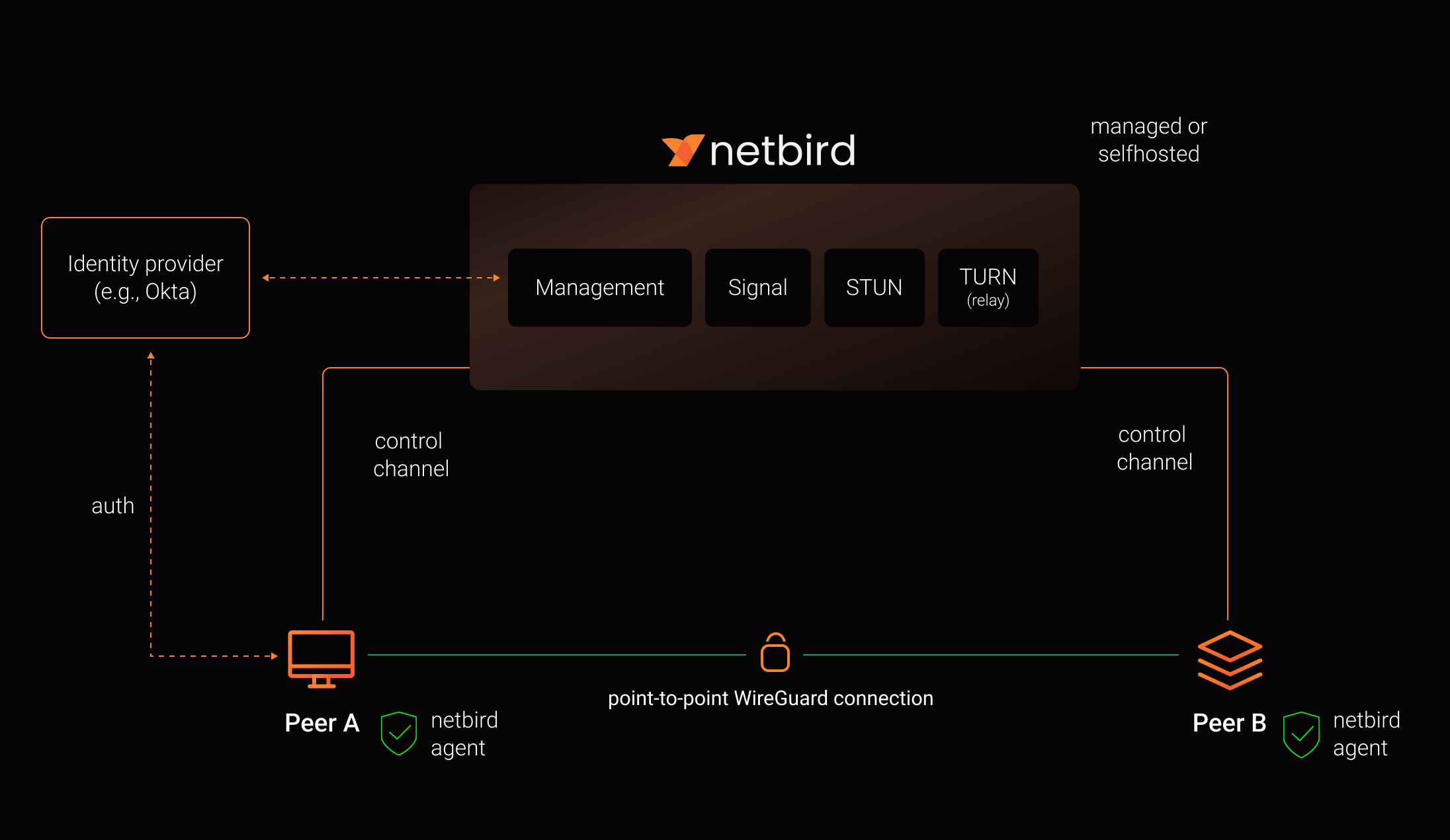
See a complete architecture overview for details.
Community projects
- NetBird installer script
- netbird-tui - terminal UI for managing NetBird peers, routes, and settings
- caddy-netbird - Caddy plugin that embeds a NetBird client for proxying HTTP and TCP/UDP traffic through NetBird networks
Note: The main branch may be in an unstable or even broken state during development.
For stable versions, see releases.
Support acknowledgement
In November 2022, NetBird joined the StartUpSecure program sponsored by the Federal Ministry of Education and Research of the Federal Republic of Germany. Together with the CISPA Helmholtz Center for Information Security, NetBird brings security best practices and simplicity to private networking.

Acknowledgements
We build on open-source technologies like WireGuard®, Pion ICE, and Rosenpass. We greatly appreciate the work these projects are doing, and we'd love it if you could support them too (e.g., by starring or contributing).
Legal
This repository is licensed under the BSD-3-Clause license, which applies to all parts of the repository except for the directories management/, signal/ and relay/. Those directories are licensed under the GNU Affero General Public License version 3.0 (AGPLv3). See the respective LICENSE files inside each directory.
WireGuard and the WireGuard logo are registered trademarks of Jason A. Donenfeld.